
Sex Offender Checks in Chilton County
The Alabama Law Enforcement Agency runs the statewide public registry. Local law enforcement collects registration data, photographs, and fingerprints, then sends updates to ALEA. For Chilton County, the public starting point is the ALEA Sex Offender Registry page, which links to the official Community Information Center search. The Chilton County Sheriff's Office is the local contact when an address appears wrong or a registrant may not be compliant.
A registry search can be based on a known name or a place. County, city, ZIP, and geographic-radius searches support neighborhood awareness. ALEA says its public system updates daily in real time, yet the result still depends on accurate local reporting. A date stamp and direct agency check matter when a safety decision turns on a recent move.
Chilton County Registry Data Flow
Chilton County and ALEA have different roles. The sheriff handles local contact and registration work, while ALEA maintains the statewide public view. The Chilton County Sheriff's Office also includes an official sex-offender feature, but the research did not establish a separate Chilton-only database with broader fields. Call CCSO at 205-755-4698 before visiting because a distinct registration counter or verification schedule was not posted.
The manifest's first successful registry image comes from the official ALEA registry FAQ and launch page.
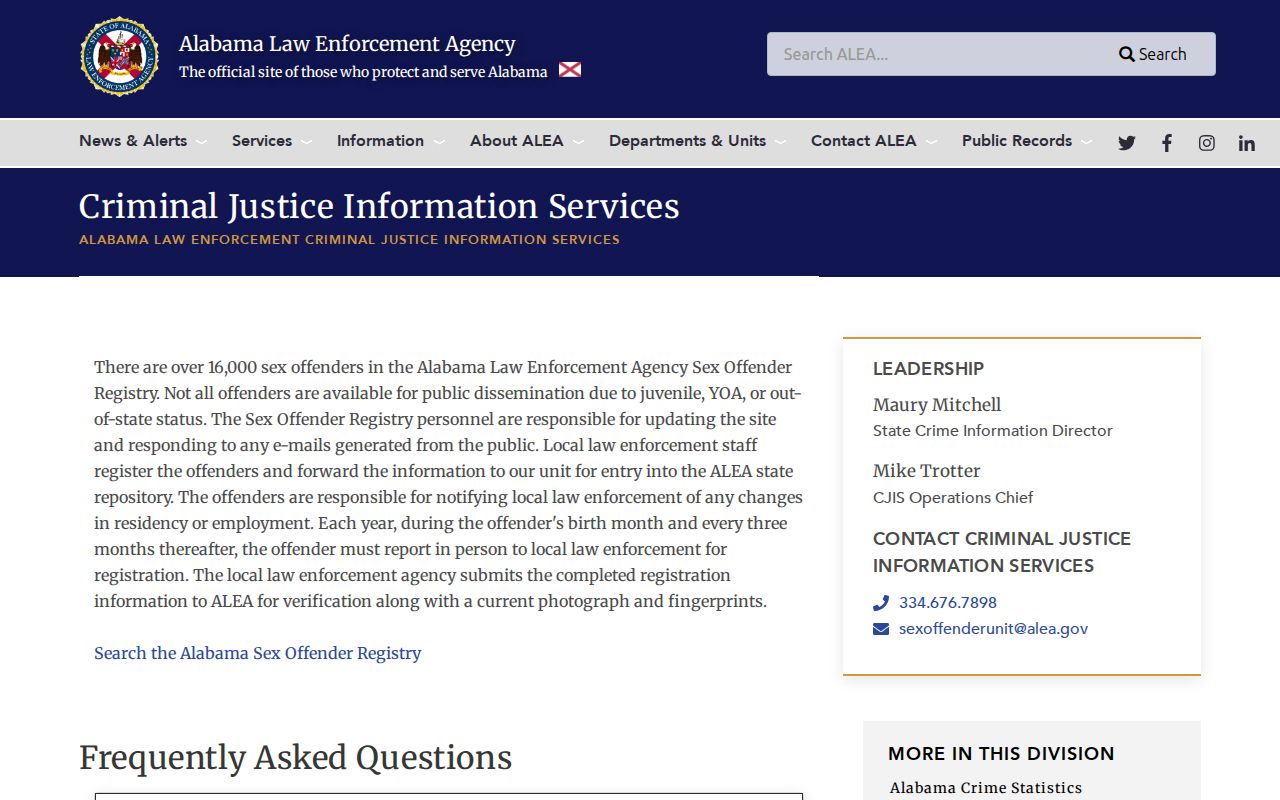
The state page is useful for search access, update guidance, public-display limits, and the correct reporting route when a record seems stale.
Registry flow: Local Registration › Chilton County Verification › ALEA Update › Public Search › Error Report
How to Search the Alabama Law Enforcement Agency Sex Offender Registry
ALEA's official page sends users to a vendor-hosted search. The interface presented a JavaScript challenge during research, so exact button labels and radius choices could not be confirmed. Alabama law does verify the core search dimensions. Do not infer an absent control from a blocked browser session. Use the fields that the live official interface displays.
- Open the ALEA registry launch page and follow its official search link.
- Search by name, or choose Chilton County, a city or town, a ZIP code, or an address-based radius.
- Compare the result details carefully so a similar name or nearby address is not mistaken for the intended profile.
- Open the public profile and review the offense, address, photograph, vehicle, and status fields that are shown.
| Search dimension | Type | Required | Chilton County use |
|---|---|---|---|
| Name | Text | Not specified | Check a known identity or alias |
| City or town | Text/select | Optional | Focus on a Chilton County municipality |
| County | Select | Optional | Choose Chilton for a county-wide view |
| ZIP code | Text | Optional | Focus on a postal area |
| Geographic radius | Address/map | Optional | Check the area around a location |
Chilton County Registry Updates
ALEA describes the registry as updating daily in real time. That phrase means new local data can move to the state display quickly. It does not mean every address is correct at every moment. A move that was not reported, a delayed local entry, or a person shown as absconded can leave a mismatch between the profile and current facts.
When a Chilton County address seems wrong, do not confront anyone at the listed residence. Record the public profile and use the sheriff's official contact channels. CCSO can be reached at 205-755-4698. The ALEA Registry Unit is available at 334-676-7898 or sexoffenderunit@alea.gov. Give the agency enough detail to identify the record and explain the suspected error without sharing the profile more widely than needed.
Inside a Registry Profile
Ala. Code § 15-20A-8 defines the public information that may appear. The Chilton County registry result can include identity, location, vehicle, photograph, physical description, offense history, statutory offense text, and a status such as absconded. The law-enforcement registration record is broader than the public profile, so a field listed in an administrative rule should not be assumed public.
| Name and aliases | Public identity names used to distinguish the listed person. |
|---|---|
| Photo and description | Current photograph and physical traits authorized for public display. |
| Addresses | Residence, school, and work locations when public under Alabama law. |
| Vehicles | Plate and vehicle description that may help confirm the correct profile. |
| Offense history | Qualifying sex-offense conviction or adjudication information and statutory text. |
| Registration status | May flag a status such as absconded; contact law enforcement about suspected noncompliance. |
The public view excludes nonconviction arrests, Social Security numbers, travel and immigration numbers, victim identity, and Internet identifiers.
Chilton County Registry Profiles
Alabama's law-enforcement registration record contains more than the public Chilton County profile. Administrative Rule 760-X-3-.03 allows internal data such as dates of birth, FBI, SID, and AIS identifiers, phone numbers, email addresses, fingerprints, palmprints, DNA status, supervision, and warrants. Public access under § 15-20A-8 is narrower.
This difference protects sensitive data while keeping facts tied to community awareness in view. A searcher should not treat a blank public field as proof that the agency lacks it. Likewise, the public registry is not an arrest database. It reports qualifying registration status, not all allegations or all criminal history. Court records remain the source for the underlying judgment and filed case details.
Alabama Registration Levels and Requirements
Alabama does not use a simple public Tier I, Tier II, and Tier III chart with ordinary 10-year, 25-year, and lifetime periods. The public treatment depends on adult, juvenile, youthful-offender, first-conviction, and out-of-state or other status rules. Applying a generic three-tier chart to a Chilton County search would be misleading.
| Alabama category | Public treatment or duration | Verification |
|---|---|---|
| Adult subject to ASORCNA | Generally lifetime | Birth month and every three months afterward |
| Juvenile adjudication | Usually not public unless assessed High Risk | Depends on the separate risk process |
| Youthful offender | Generally nonpublic unless an exception applies | Governed by applicable status rules |
| Out-of-state, federal, military, or tribal case | Posting may follow an applicability determination | Depends on the determination |
| First Indecent Exposure or Sexual Misconduct conviction | ALEA says it does not appear; a later qualifying conviction changes duties | Depends on later qualifying status |
Adult registrants generally verify in person during the birth month and every three months thereafter. Local law enforcement sends ALEA updated data, photographs, and fingerprints.
Chilton County Registry Residence Rules
Ala. Code § 15-20A-11 generally bars an adult offender from living within 2,000 feet, measured property line to property line, of a school, childcare facility, resident camp, or the former victim or immediate family. The rule is a legal residence restriction. It does not convert every map point into a precise boundary survey.
For a Chilton County safety concern, use the registry map to identify the listed location, then ask the proper law-enforcement agency about compliance. Do not measure from a browser pin and declare a violation. Address geocoding can be imprecise, and the statute depends on property lines and legally defined places. Report facts and let the agency apply the law.
Note: An old Chilton County address may signal noncompliance, but only law enforcement should investigate and determine the next legal step.
Chilton County National Registry Search
The Dru Sjodin National Sex Offender Public Website searches participating jurisdictions across state lines. It is useful when a name or recent move may involve more than Alabama. NSOPW supplements the ALEA registry. It does not replace Chilton County verification or make the national result more current than its source jurisdiction.
The second successful registry image in the manifest comes from the official national NSOPW search service.
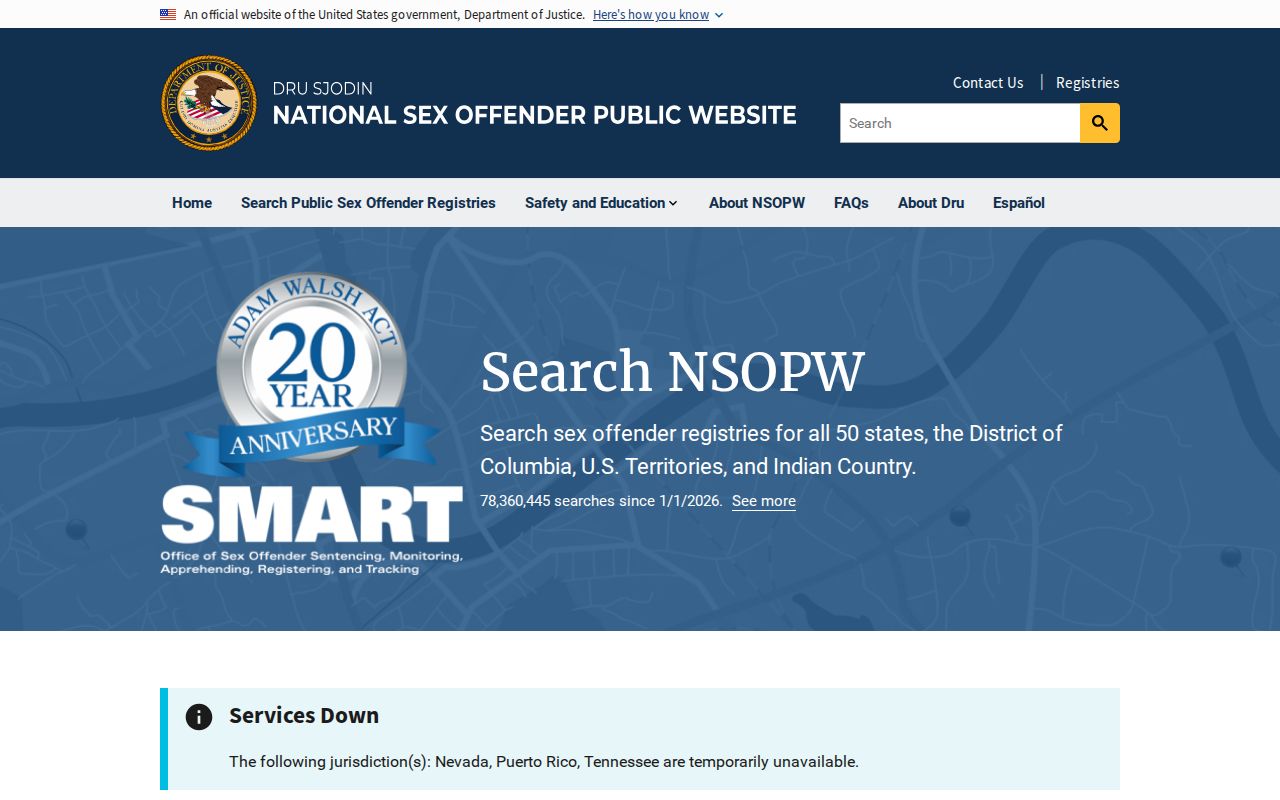
The national layer is most useful as a cross-state check, followed by the official profile and local agency in the jurisdiction that supplied it.
Start with ALEA for a Chilton County address. Use NSOPW when the search may cross state lines. If the two services differ, save the date and contact the source agency rather than guessing which screen is right.
Community Notification and Lawful Use
Registry information supports personal, family, and neighborhood safety. It can help residents learn which locations are reported, read the qualifying offense information, and contact law enforcement about a suspected error. It is not permission to threaten a listed person, confront a household, damage property, or use the record to commit another offense.
Misuse can be a crime: Ala. Code § 15-20A-8 governs Alabama's public registry information, and the official portal warns that using it to injure, harass, or commit a crime against a registrant or anyone at a reported address is prohibited.
Community notification works only when the information is used with care. Confirm a profile through ALEA and report suspected noncompliance to CCSO or the ALEA Registry Unit. Do not spread an address as fact after learning that it may be stale. A current official response is safer than direct contact.
Keep the search date, the official profile link, and the specific field that raised concern. For a suspected Chilton County address error, give that focused information to CCSO. The sheriff's official app page also routes residents to agency tools and alerts. For a question about statewide display or category treatment, contact ALEA's Registry Unit. This division of work helps the agency that owns the data review it. It also prevents a public search from turning into rumor or an unsafe encounter at a reported home, school, or work address.